
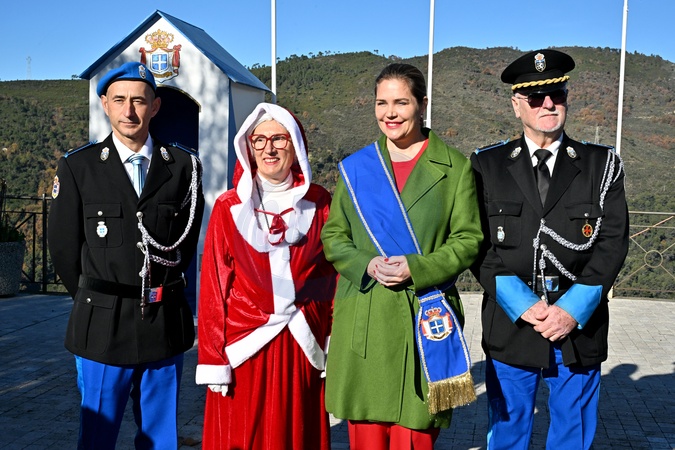
Exclusif - No web - Nina Menegatto, la princesse de Seborga, lance les festivités de Noël, dans sa Principauté située au dessus de Bordighera (Italie)
Nina Menegatto, księżniczka Seborgi uroczystości bożonarodzeniowe w swoim Księstwie we Wloszech
Nr zdjęcia:
3240375
Data:
2023-12-17
Opis:
Exclusif - No web - Nina Menegatto, la princesse de Seborga, lance les festivités de Noël, dans sa Principauté, le 17 décembre 2023, située au dessus de Bordighera en Italie. Une Principauté sans existence légale mais reconnue par ses sujets et toujours dans l'attente de sa reconnaissance officielle devant les tribunaux. Le 3 avril 954, le comte Guidone de Vintimille, qui était sur le point de partir combattre "contra perfidos Saracenos" aux côtés de Guillaume le Libérateur, comte de Provence, fit don du territoire de Seborga aux moines bénédictins de l'abbaye de Lérins; cette abbaye située sur les îles de Lérins, en face de Cannes et à l'époque faisait partie du comté de Provence, division du royaume d'Arles (qui était né entre-temps). L'acte notarié de donation, aujourd'hui conservé à Turin, est considéré par presque tous les historiens comme un document apocryphe, mais il est certain que la donation a effectivement eu lieu. En fait, un document original est parvenu à ce jour portant une sentence de 1177 sur un différend survenu sur les frontières entre les propriétés des moines et celles des comtes de Vintimille, et dans ce document authentique la donation est explicitement confirmée. La donation concernait une superficie d'environ 14 km2. À partir de 1079, avec l'autorisation du pape Grégoire VII, selon la coutume répandue de l'époque, les abbés de Lérins purent revendiquer le titre de Princes-Abbés de Seborga, bénéficiant du soi-disant "mero et libero imperio cum gladii potestate" (c'est-à-dire le droit d'imposer la peine de mort, mais jamais exercée à Seborga). Par conséquent, l'Abbé prétendait être indépendant du clergé séculier et dépendre exclusivement et directement du Pape («nullius dioecesis»). La souveraineté appartenait à l'abbé de Lérins, qui l'exerçait cependant rarement. Le même titre de Prince de Seborga commença à être utilisé surtout à partir du 17ème siècle. En fait, le Podestà commandait à Seborga: il était souvent choisi par le Prince-Abbé et en tout cas devait toujours être approuvé par lui. Sa tâche principale était de juger les personnes accusées d'avoir commis un crime sur le territoire de la Principauté. Au cours des siècles suivants, Seborga fut l'objet à plusieurs reprises de l'attention de la République de Gênes (qui entre-temps avait incorporé le comté préexistant de Vintimille depuis 1030), qui tenta à plusieurs reprises de l'annexer, irritée par le fait d'avoir une enclave à l'intérieur de son territoire qui échappait à son contrôle politique. En 1697, alors que Joseph de Meyronnet était Prince-Abbé, une première vente préliminaire fut conclue avec le duc de Savoie Victor-Amédée II. Cependant, la République de Gênes, qui continuait à mal tolérer l'hypothèse d'avoir une enclave sur son territoire et qui voulait donc prendre possession de Seborga à tout prix, fit pression sur le roi Louis XIV de France, sur l'évêque de Vintimille et sur le pape Innocent XII pour obtenir une prolongation des négociations avec la Maison de Savoie. Entre-temps, aussi des particuliers s'intéressèrent à la vente, comme le comte Modénien Vespucci, Françoise-Athénaïs de Montespan (amante officielle du roi de France Louis XIV), le bolognais Filippo Ercolani et les Grimaldis de Monaco, ainsi que quelques figures de proue pour la République de Gênes, comme Ernesto Lercari de Taggia, Renato Sauli de Gênes et la République de Gênes elle-même, par l'intermédiation du marquis Doria. Le 30 janvier 1729, l'acte de vente de Seborga fut signé à Paris en présence de l'avocat Francesco Lea, représentant le roi de Sardaigne, et des pères Benoît de Benoît et Lambert Jordany, respectivement trésorier et doyen de l'abbaye de Lérins, en représentation du Prince-Abbé Fauste da Ballon. Cet acte, qui n'a jamais été enregistré, ne prévoyait pas explicitement que le roi de Sardaigne acquerrait la souveraineté sur Seborga (à tel point que «Prince of Seborga» n'apparaît jamais parmi ses titres officiels), mais tout simplement que le territoire de Seborga deviendrait sa possession personnelle, sur lequel il exercerait le rôle de protecteur (ius patronatus); sans surprise, l'achat (qui n'a jamais été payé) aurait dû être fait avec les finances personnelles du roi et non avec celles du royaume de Sardaigne. Sur ces thèses, la Principauté de Seborga prétend être indépendante encore aujourd'hui: dans la vente de la Principauté en 1729, la souveraineté sur Seborga serait tombée sur le peuple de Seborga en l'absence d'une clause explicite prévoyant le transfert de celui-ci au roi de Sardaigne, et les Seborgiens ne l'auraient pas exercée activement pendant près de deux siècles, se contentant d'accepter tacitement le fait que la gestion effective du pays était confiée au roi de Sardaigne par l'intermédiaire de ses émissaires. Le peuple de Seborga se réunit librement et spontanément le 14 mai 1963 et élit comme Prince de Seborga Giorgio Carbone, un citoyen de Seborga passionné d'histoire qui a toujours été un partisan de l'indépendance de l'Etat italien, qu'aujourd'hui exerce de facto illégalement sa souveraineté sur Seborga. Surtout depuis les années 1990, le Prince Giorgio Ier a refondé les institutions de Seborga: Seborga a repris les anciennes armoiries souveraines, le drapeau blanc et bleu, l'ancienne devise «Sub Umbra Sedi». Le 3 avril 1994, des élections ont eu lieu pour la nomination d'un gouvernement constituant. Le 23 avril 1995, le peuple a approuvé la nouvelle constitution (les «Statuts Généraux» et le «Règlement») avec 304 voix pour et 4 contre. Le 20 août 1996, anniversaire de Saint Bernard, Giorgio Ier a officiellement réaffirmé l'indépendance de la Principauté, avec la proclamation suivante: «Nous Giorgio Ier, Prince de Seborga par la grâce de Dieu et par la volonté du Peuple Souverain, par le droit et dans le droit international en vigueur dans tous les Etats à constitutions démocratiques et modernes, réaffirmons et décrétons la souveraineté territoriale, juridique, religieuse, civile, morale et matérielle de la Principauté de Seborga». Le 5 avril 2007, la juge Erika Cannoletta de la Cour de Sanremo, en prononçant une sentence sur un différend entre des Seborgiens, a déclaré que l'État italien n'avait pas compétence sur Seborga. En revanche, le 14 janvier 2008, la Cour Constitutionnelle a déclaré l'irrecevabilité de la question de la légitimité constitutionnelle. Un nouveau pourvoi a donc été lancé devant la Cour Européenne des Droits de l'Homme à Strasbourg, qui a cependant été jugé irrecevable le 12 décembre 2012. Le prince Giorgio Ier (qui entre-temps est tombé malade de la sclérose latérale amyotrophique) est décédé le 25 novembre 2009. Le 25 avril 2010, Marcello Menegatto a été élu Prince de Seborga (avec le nom de Marcello Ier) par des élections ouvertes, et il a été réélu encore pour sept ans le 23 avril 2017. Le 12 avril 2019, le Prince Marcello a annoncé son intention d'abdiquer, restant en fonction jusqu'à l'élection de son successeur. Le 10 novembre 2019, Nina Menegatto a été élue Princesse de Seborga, la première femme de l'histoire à occuper ce poste. © Bruno Bebert / Bestimage Exclusive - No web - Nina Menegatto, the Princess of Seborga, launches the Christmas festivities in her Principality on December 17, 2023, located above Bordighera in Italy. A Principality without legal existence but recognized by its subjects and still awaiting its official recognition before the courts. On April 3, 954, Count Guidone de Ventimiglia, who was about to leave to fight "contra perfidos Saracenos" alongside William the Liberator, Count of Provence, donated the territory of Seborga to the Benedictine monks of the Abbey of Lérins ; this abbey located on the Lérins islands, opposite Cannes and at the time was part of the county of Provence, a division of the kingdom of Arles (which had been born in the meantime). The notarial deed of donation, now kept in Turin, is considered by almost all historians to be an apocryphal document, but it is certain that the donation actually took place. In fact, an original document has survived to this day bearing a sentence from 1177 on a dispute over the boundaries between the properties of the monks and those of the counts of Ventimiglia, and in this authentic document the donation is explicitly confirmed. The donation concerned an area of approximately 14 km2. From 1079, with the authorization of Pope Gregory VII, according to the widespread custom of the time, the abbots of Lérins were able to claim the title of Prince-Abbots of Seborga, benefiting from the so-called "mero et libero imperio cum gladii potestate" (i.e. the right to impose the death penalty, but never exercised in Seborga). Consequently, the Abbot claimed to be independent of the secular clergy and to depend exclusively and directly on the Pope ("nullius dioecesis”). Sovereignty belonged to the Abbot of Lérins, who however rarely exercised it. The same title of Prince of Seborga began to be used especially from the 17th century. In fact, the Podestà commanded Seborga: he was often chosen by the Prince-Abbot and in any case always had to be approved by him. Its main task was to judge people accused of having committed a crime on the territory of the Principality. In the following centuries, Seborga was repeatedly the object of the attention of the Republic of Genoa (which in the meantime had incorporated the pre-existing county of Ventimiglia since 1030), which repeatedly attempted to annex it, irritated by having an enclave within its territory which escaped its political control. In 1697, when Joseph de Meyronnet was Prince-Abbot, a first preliminary sale was concluded with the Duke of Savoy Victor-Amédée II. However, the Republic of Genoa, which continued to have difficulty tolerating the hypothesis of having an enclave on its territory and which therefore wanted to take possession of Seborga at all costs, put pressure on King Louis XIV of France, on the bishop of Ventimiglia and on Pope Innocent XII to obtain an extension of negotiations with the House of Savoy. In the meantime, individuals were also interested in the sale, such as the Modenian Count Vespucci, Françoise-Athénaïs de Montespan (official lover of the King of France Louis XIV), the Bolognese Filippo Ercolani and the Grimaldis of Monaco, as well as some figures figureheads for the Republic of Genoa, such as Ernesto Lercari of Taggia, Renato Sauli of Genoa and the Republic of Genoa itself, through the intermediation of Marquis Doria. On January 30, 1729, the deed of sale of Seborga was signed in Paris in the presence of the lawyer Francesco Lea, representing the King of Sardinia, and Fathers Benoît de Benoît and Lambert Jordany, respectively treasurer and dean of the Abbey of Lérins, representing the Prince-Abbot Fauste da Ballon. This act, which was never recorded, did not explicitly provide that the King of Sardinia would acquire sovereignty over Seborga (so much so that "Prince of Seborga" never appears among his official titles), but quite simply that the territory of Seborga would become his personal possession, over which he would exercise the role of protector (ius patronatus); unsurprisingly, the purchase (which was never paid for) should have been made with the king's personal finances and not those of the Kingdom of Sardinia. On these theses, the Principality of Seborga claims to be independent even today: in the sale of the Principality in 1729, sovereignty over Seborga would have fallen to the people of Seborga in the absence of an explicit clause providing for the transfer of that -this to the king of Sardinia, and the Seborgians would not have exercised it actively for almost two centuries, contenting themselves with tacitly accepting the fact that the effective management of the country was entrusted to the king of Sardinia through his emissaries . The people of Seborga met freely and spontaneously on May 14, 1963 and elected as Prince of Seborga Giorgio Carbone, a citizen of Seborga passionate about history who had always been a supporter of the independence of the Italian State that today de facto illegally exercises its sovereignty over Seborga. Especially since the 1990s, Prince Giorgio I refounded the institutions of Seborga: Seborga took over the old sovereign coat of arms, the white and blue flag, the old motto "Sub Umbra Sedi”. On April 3, 1994, elections were held for the appointment of a constituent government. On April 23, 1995, the people approved the new constitution (the "General Statutes” and the "Regulations”) with 304 votes for and 4 against. On August 20, 1996, the birthday of Saint Bernard, Giorgio I officially reaffirmed the independence of the Principality, with the following proclamation: "We Giorgio I, Prince of Seborga by the grace of God and by the will of the Sovereign People, by the law and international law in force in all States with democratic and modern constitutions, let us reaffirm and decree the territorial, legal, religious, civil, moral and material sovereignty of the Principality of Seborga. On April 5, 2007, Judge Erika Cannoletta of the Court of Sanremo, in passing sentence on a dispute between Seborgians, declared that the Italian state did not have jurisdiction over Seborga. On the other hand, on January 14, 2008, the Constitutional Court declared the question of constitutional legitimacy inadmissible. A new appeal was therefore launched before the European Court of Human Rights in Strasbourg, which was however deemed inadmissible on December 12, 2012. Prince Giorgio I (who in the meantime fell ill with amyotrophic lateral sclerosis) died on November 25, 2009. On April 25, 2010, Marcello Menegatto was elected Prince of Seborga (with the name Marcello I) by open elections , and he was re-elected for another seven years on April 23, 2017. On April 12, 2019, Prince Marcello announced his intention to abdicate, remaining in office until the election of his successor. On November 10, 2019, Nina Menegatto was elected Princess of Seborga, the first woman in history to hold this position.
Fotograf:
najlepszy
Wielkość zdjęcia:
7975 x 5317
Kategoria:
Brak
Restrykcje sprzedaży:
Brak
Słowa kluczowe:
Brak